The Persistence Filter
We’ve spent most of the internet age trying to make information easier to reach. Archives were digitized, the web was indexed, papers became searchable, and sources that once required a library, an expert, or a great deal of patience moved within a few clicks. Search changed the scale of access, but it left a familiar arrangement largely intact. It helped us find the source. We still had to open it, decide whether we trusted it, and work out what it meant.
Artificial intelligence changes the order of that experience. Increasingly, the source is no longer the first thing we encounter. We ask a question and receive an explanation assembled for us in the moment, often from material we may never see directly. The paper, book, report, documentation, or person who knew something remains somewhere behind the answer, but it is no longer necessarily where understanding begins.
There are good reasons for that. The explanation may be clearer than the original, better organized, and closer to the question we were actually trying to answer. It can translate unfamiliar language, connect the material to things we already know, and give us enough context to decide whether the source deserves more of our time.
Sometimes it leads us back.
Sometimes it becomes the only version we ever know.
You can already see this in ordinary work. A developer asks an assistant about an unfamiliar library before opening the documentation. An executive reads a briefing assembled from reports they’ll never have time to read. A researcher asks for the shape of a field before deciding which papers deserve closer attention. Inside organizations, the chain can extend further. A meeting transcript becomes a summary, the summary becomes a plan, and the plan becomes a status update that someone else uses to make a decision. Nothing in that sequence is necessarily unreasonable, but the distance accumulates anyway.
Knowledge has always passed through interpretation. People remember, explain, compress, and adapt what they know for other people. What has changed is that a general-purpose machine can now perform that work between the source and the person trying to understand it, at almost any point in the chain and at a scale no human intermediary could approach.
Knowledge has always passed through someone
Very little of what any of us knows came directly from an original source. We learned from parents, teachers, authors, journalists, professors, colleagues, clergy, editors, and people with more experience than we had. Each person selected what seemed important, translated it into terms we might understand, and left things out. Even when we read the source ourselves, we brought assumptions and prior knowledge that shaped what we understood.
Frederic Bartlett demonstrated this nearly a century ago. His work on memory showed that people don’t preserve an experience and play it back intact; they reconstruct it. Unfamiliar material is shortened, reorganized, and pulled toward patterns that make sense within the person’s existing view of the world. Memory doesn’t operate like storage. It produces a workable version of the past each time the past is recalled.
Cultural transmission works much the same way. An idea passes from one person to another, but the next person doesn’t receive the first person’s mental representation verbatim; they build their own. Dan Sperber described culture less as the replication of stable objects than as a population of related representations, repeatedly transformed as they move through minds and environments.
That process can preserve an idea remarkably well, but it also changes it along the way. Stories become easier to retell, complicated events acquire cleaner causes, and unfamiliar details fall away. A concept that works in one setting gets adapted for another until, after enough retellings, it may bear only a loose resemblance to the version that began the journey.
That possibility is why the identity of the teacher, reporter, translator, or interpreter matters. An intermediary carries more than information. They also bring judgment about what deserves emphasis, what can be omitted, and what belongs in the next version.
Print made the chain easier to forget
Walter Ong’s work on oral cultures makes that earlier arrangement easier to see. Without writing, knowledge survives only if people can remember it well enough to pass it on. Rhythm, repetition, familiar structures, and formulaic language aren’t merely stylistic choices in that environment. They help ideas hold their shape long enough to be told again.
That doesn’t make oral transmission unreliable in any simple sense. Many oral traditions have preserved histories and genealogies across generations. It does mean, however, that the material has to fit the conditions under which it travels. An idea that can’t be remembered, performed, or reconstructed has a limited future.
Print changed those conditions. Elizabeth Eisenstein’s work on the printing press describes a shift that went far beyond producing more books. Identical copies could circulate across distance and remain available over time. Readers could compare versions. Scholars could cite an exact passage and expect another scholar to find the same words. Errors could be discovered because the underlying artifact had stopped drifting.
That stability supported forms of knowledge that memory alone could rarely sustain. Arguments grew longer and more intricate. Tables, diagrams, taxonomies, and reference works accumulated detail without requiring anyone to hold the entire structure in mind. Later writers could begin with what earlier writers had preserved instead of reconstructing it through a living teacher.
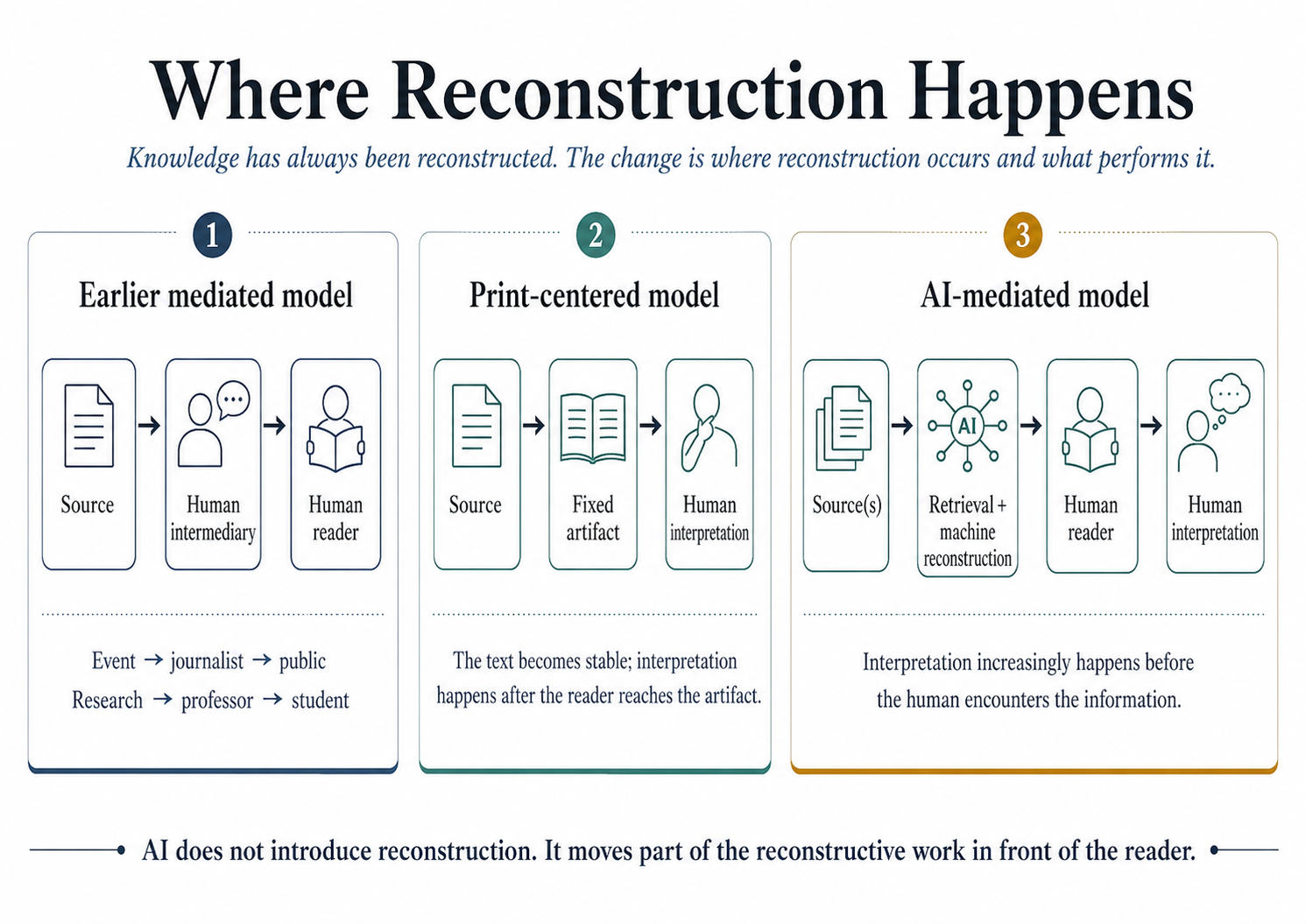
Print didn’t eliminate interpretation or remove the intermediaries around it. Readers still relied on critics, teachers, editors, reviewers, publishers, schools, libraries, and professional institutions to decide what deserved attention. What changed was the object underneath that interpretation. However much people disagreed about a book, the text remained stable and available for another look. Readers could return to the same words and perform their own interpretation from there.
AI alters that sequence. The source may still be available, but interpretation and reconstruction increasingly happen before the reader reaches it. What arrives first is often a version already selected, compressed, and explained by the system.
Search decided what could be found
By the time language models began explaining information, search had already placed an algorithmic gatekeeper between the source and the reader. Search engines were built to shorten the path between a question and an answer, but they also determine which paths are easiest to follow. They don’t create the material or interpret it in the same way generative systems do. They rank it, and that ranking helps decide which sources become visible enough to enter active knowledge.
That influence is easy to underestimate because search presents itself as retrieval. The information exists somewhere, and the search engine simply helps us find it. In practice, ranking shapes which parts of the web are visible enough to matter. A source buried several pages down technically remains available, but availability without discovery does little to keep an idea active.
The web has adapted to the filter. Titles change, pages are organized around search terms, and concepts with stable names become easier to locate than ideas described differently by every community that uses them. Link structures, popularity, recency, authority signals, and the growing machinery of search optimization all help determine what rises to the surface.
Search doesn’t decide what exists, but it plays a large role in deciding what people encounter. Over time, it has become a filter on practical knowledge.
Social media adds another. An idea has to compete within a feed, where emotional response, immediate recognition, social identity, and speed all matter. The underlying article may be careful and qualified. The version that travels is often the sentence that can survive separation from it.
Neither search nor social media removes the source. The link usually remains somewhere in the chain, even when far fewer people follow it than the surrounding activity suggests.
Generative systems change that relationship again. They can take on much of the work the reader once performed after retrieval. They select material, reconcile it, compress it, and present a finished account. The source may be cited or available on request. It may also disappear behind an answer that feels complete enough to stand on its own.
The persistence filter
Across oral tradition, print, search, social media, and now generative systems, the mechanism changes but the effect is similar. Each establishes conditions an idea has to meet to remain part of active knowledge. An idea may still exist somewhere and yet effectively disappear if it cannot be remembered, published, found, ranked, shared, or reconstructed.
That pattern is what I mean by a persistence filter.
A persistence filter is broader than storage. An idea can remain intact in an archive and still fall out of active knowledge if nobody can find it, understand it, connect it to a current problem, or recognize that it matters. Persistence depends on continued availability, but also on whether an idea can still move through the systems people use to learn and decide.
Those systems impose different requirements. Oral traditions depended on memory and retelling. Print added publication, preservation, and distribution, along with institutions that decided what was worth reading. Search made indexing and ranking central to whether an idea would be encountered. Social platforms intensified the importance of immediate recognition and response. Each layer carries forward some of what came before while adding new conditions of its own.
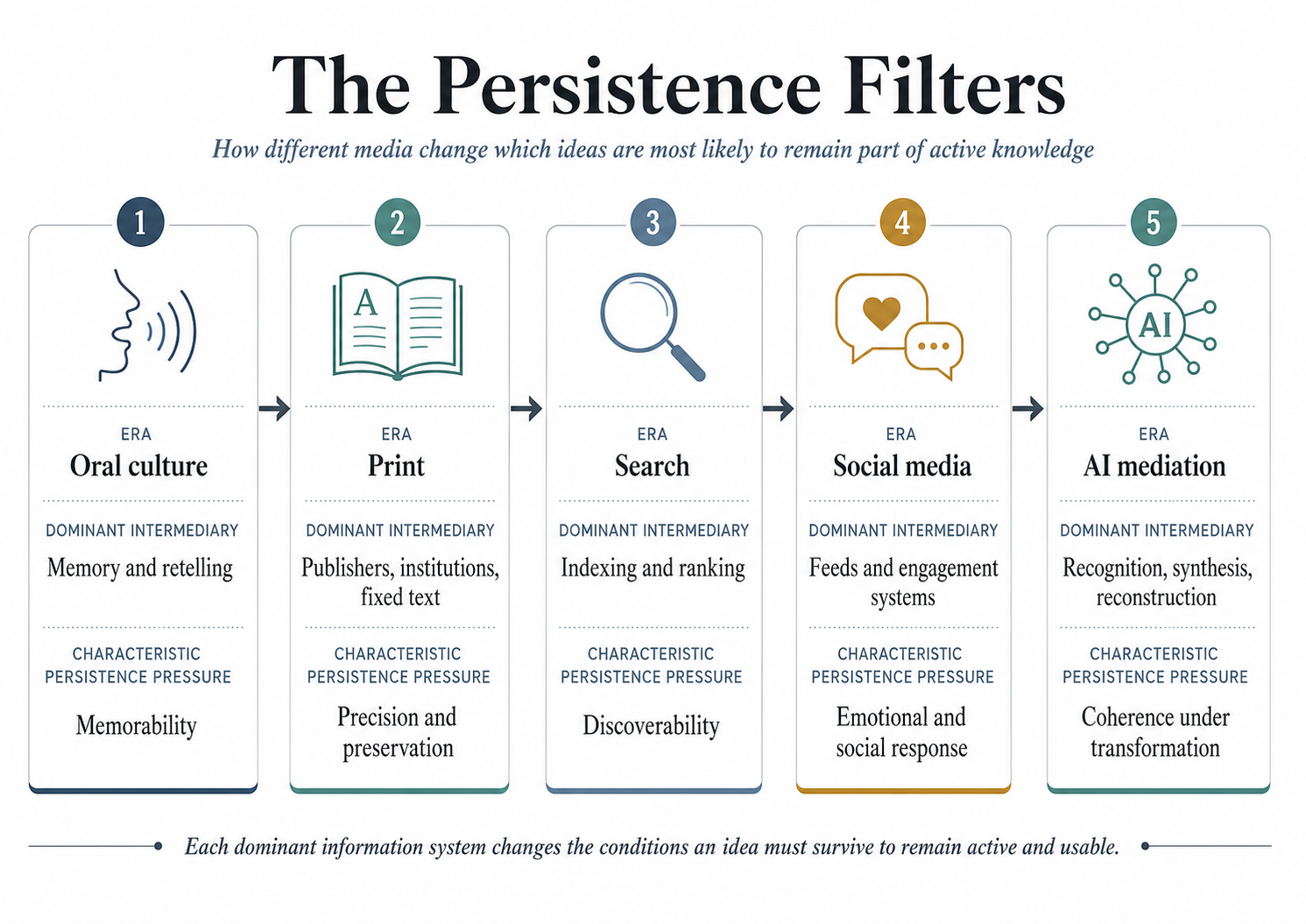
Generative systems add a new requirement. The model first has to recognize an idea in its training or retrieved sources, then carry it through whatever transformation the user requests. It may reappear as a paragraph, a comparison, an executive summary, a recommendation, or an introduction for someone new to the subject. The form changes, but the idea still has to hold together.
Being found is no longer enough. The idea also has to hold together while being repeatedly reconstructed.
Some ideas move through this process more easily than others. A well-known concept with a stable name gives the system something clear to recognize and work from. Terms like opportunity cost, technical debt, entropy, or Goodhart’s Law can call up a much larger body of thought with only a few words. From there, the system can explain the same idea in different forms without having to rebuild it from scratch each time.
Other kinds of knowledge travel less easily. Local knowledge often depends on details that were never documented. Emerging ideas may not yet have settled into a shared vocabulary. Disagreement can disappear when a system is asked to produce a single answer, while context that mattered deeply to the original author may be lost through repeated compression.
That doesn’t mean AI will always reinforce conventional thinking or flatten every subject into an average. The same systems can expose people to work they would never have found through their own search habits, translate across disciplines, and make specialized knowledge accessible to readers who lack the time or background to enter through the usual door.
The filter can expand access while still favoring some forms of knowledge over others. The important question is what passes through easily, what arrives altered, and what remains outside the answer altogether.
What survives machine reconstruction
One property appears especially valuable under machine reconstruction: an idea’s ability to keep its shape while the form around it changes. Memorability helps, although a memorable phrase can travel far after the reasoning behind it has fallen away. Precision helps too, but a precisely stated idea may remain tied to the language of the original source.
The better test is whether the idea can be shortened, expanded, translated for a new audience, or applied in a different setting without losing the relationships that give it meaning. Ideas with that combination of structure and flexibility are easier for machines to carry forward.
A strong concept does more than name something. It gives people a way to recognize the same pattern in situations that look different on the surface. Once the concept is understood, they can apply it without carrying every original example with them.
Technical debt lets a team see the future cost hidden inside a convenient technical choice. Opportunity cost brings attention to what a decision rules out. Ambient authority makes it easier to spot risk created by access that already exists around an action. Each concept travels because it gives people a practical way to interpret a new case.
That portability matters more when machines are doing much of the explaining. Once a concept has a clear name and an established meaning, a model can call it up, adapt it for a new audience, and apply it to a different problem with very little friction.
The reverse is also true. Ideas that depend on local history, unresolved disagreement, or details that resist a clean label are harder to carry through the same process. They may still be important, but they are less likely to appear unless the source material is present and the question points directly toward them.
A persistence filter doesn’t have to erase an idea to weaken it. It only has to make other ideas easier to find, explain, and reuse.
Fluency changes the risk
The obvious concern is accuracy. Models can invent sources, merge distinct claims, miss important qualifications, and state uncertain material with more confidence than it deserves. Those problems are real, but they don’t fully capture what changes when AI becomes an intermediary.
Human intermediaries are visible. We know that a teacher is explaining a book, a journalist is interpreting an event, or a colleague is summarizing a meeting. Their presence reminds us that we’re receiving a perspective.
Machine mediation can be harder to recognize because the explanation appears in direct response to our own question. It feels personal and immediate. The system adjusts to our vocabulary, our level of expertise, and the particular decision we’re trying to make. That responsiveness can make the answer feel closer to direct understanding than a book written for an unknown reader ever could.
It’s still an interpretation.
The model has selected a frame, determined which details to include, and chosen a level at which the subject becomes manageable. A different prompt will likely produce a different account. A different model may emphasize something else. Retrieval may introduce sources the user never sees. The final answer can be accurate in every sentence and still lead the reader toward a narrower understanding than the source would have produced.
This is why provenance matters even as hallucination rates improve. The problem isn’t limited to whether an answer is false; it includes the path by which the answer became the version that someone believed.
That path is becoming part of the information itself.
The loop can become self-referential
The distance grows when one reconstruction becomes the source for the next. A report is summarized into a briefing, the briefing feeds a strategy document, and that document becomes context for an agent generating requirements. Those requirements are then summarized for someone reviewing the program. Each step can make the material clearer and easier to use. It can also move the final account farther from the observations, evidence, and uncertainty that gave the original work its substance.
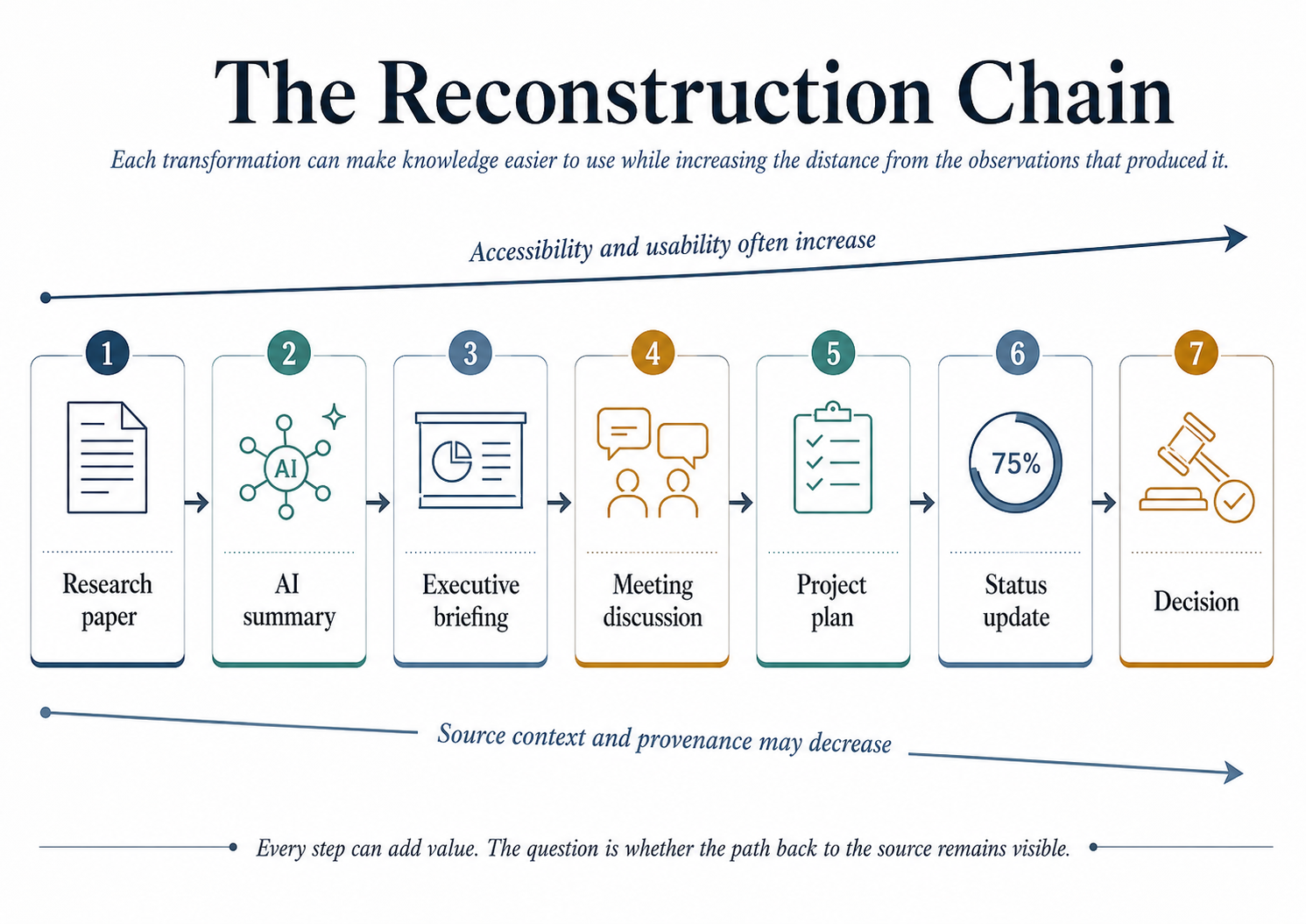
Human organizations already do this. A complicated event becomes a slide, the slide becomes a talking point, and the talking point eventually hardens into an account of what happened. AI makes each transformation cheaper, faster, and easier to repeat.
That creates a strange economy of knowledge. Producing another explanation costs almost nothing. Returning to the source still requires time.
As reconstruction becomes cheaper, derivative versions can multiply much faster than new observations. Reports, summaries, explanations, and synthetic overviews begin feeding one another, while the underlying supply of experiments, customer conversations, field notes, and close reading grows far more slowly. The volume of explanation expands faster than the body of evidence beneath it.
That can make repetition seem like confirmation. The same claim may appear across hundreds of documents even though they all trace back to the same few sources, or to one interpretation carried through the chain. By the time the claim reaches a reader, its frequency can be mistaken for independent support.
A system built around reconstruction therefore needs a steady supply of material that hasn’t already passed through the same process: new experiments, direct observation, full records, dissenting analysis, and details that don’t fit the inherited account. Without that replenishment, the system simply produces more versions of what it already knows.
Keeping the source in the system
There is no realistic return to unmediated knowledge. It never existed, and the scale of modern information makes some form of mediation unavoidable. The scientific literature alone is too large for anyone to follow directly. Organizations generate more policies, reports, messages, transcripts, and operational data than their people can absorb. AI is going to sit in that gap because the gap is real.
The practical question is how to use the intermediary without allowing it to become invisible.
That starts with treating generated answers as interpretations rather than as neutral transport. The distinction affects system design. A useful answer should preserve a path back to the material that shaped it. Summaries should make clear where certainty ends, where sources disagree, and what was excluded to produce the requested level of compression. High-stakes work needs stronger provenance than a list of plausible citations appended after the reasoning is complete.
It also affects how organizations create knowledge. The value of original observation rises when the cost of reconstruction falls. Customer conversations, experiments, incident records, field experience, dissenting analysis, and the awkward detail that doesn’t fit the accepted account become more important because they keep the loop from closing around what it already knows.
Nobody can read every source, and synthesis is one of the ways knowledge becomes usable. The discipline is to keep enough of the path visible that a person can see what was selected, what was compressed, and where judgment entered. In higher-stakes work, that path needs to remain open long enough for someone to check the evidence before the reconstruction hardens into the decision.
The same technology that creates the risk can help manage it. A model can expose competing interpretations, trace claims to evidence, identify where multiple documents repeat the same source, and show how an answer changes when different assumptions are applied. The critical design choice is whether the system uses its fluency to close the question or to make the structure underneath the answer easier to inspect.
What stands between us
Every persistence filter eventually becomes ordinary. Once it does, its choices begin to look less like choices and more like the natural shape of knowledge.
Print made fixed text feel normal. Search made ranking feel like finding. Social platforms made popularity visible enough to resemble importance. AI can make reconstruction feel like direct understanding.
That may be the deepest change underway. Artificial intelligence doesn’t have to replace human thought to influence what people think; it only has to become the place where understanding begins.
The source still exists. Human judgment still matters. People will continue to read, teach, investigate, disagree, and produce knowledge that no system could have generated from what came before. AI can widen access to that work and help more people make sense of it. It will also stand between us and more of what we know.
AI already occupies that position, and over time its presence will become easier to overlook. The path from source to answer still needs to remain visible enough to show what was selected, what was compressed, and what never entered the reconstruction. Once that path disappears, the filter begins to pass for knowledge itself.
References
Bartlett, Frederic C. Remembering: A Study in Experimental and Social Psychology. Cambridge University Press, 1932.
Eisenstein, Elizabeth L. The Printing Press as an Agent of Change: Communications and Cultural Transformations in Early-Modern Europe. Cambridge University Press, 1979.
Goody, Jack. The Interface Between the Written and the Oral. Cambridge University Press, 1987.
Ong, Walter J. Orality and Literacy: The Technologizing of the Word. Methuen, 1982.
Sperber, Dan. Explaining Culture: A Naturalistic Approach. Blackwell, 1996.